
AI Content Checklist: 12 Checks Before You Publish

A printable AI content checklist of twelve checks in four groups, with a one-minute test and a definition of good for each one.

On this page
#A checklist nobody runs is a document nobody reads
Most content checklists fail in the same way: they are written once, stuck in a shared drive, and never opened again. They are too long, too vague, or arranged in an order that does not match how a person actually reviews a draft. This AI content checklist is built to be used.
This one is built to be used. Twelve checks, four groups, about twenty minutes. Each check has a test you can run in under a minute and a description of what "good" looks like. It assumes the article was drafted with AI assistance and that a human is accountable for the result. If you want the design behind the checks — blockers, warnings, and where the gate runs — our quality control guide covers that.
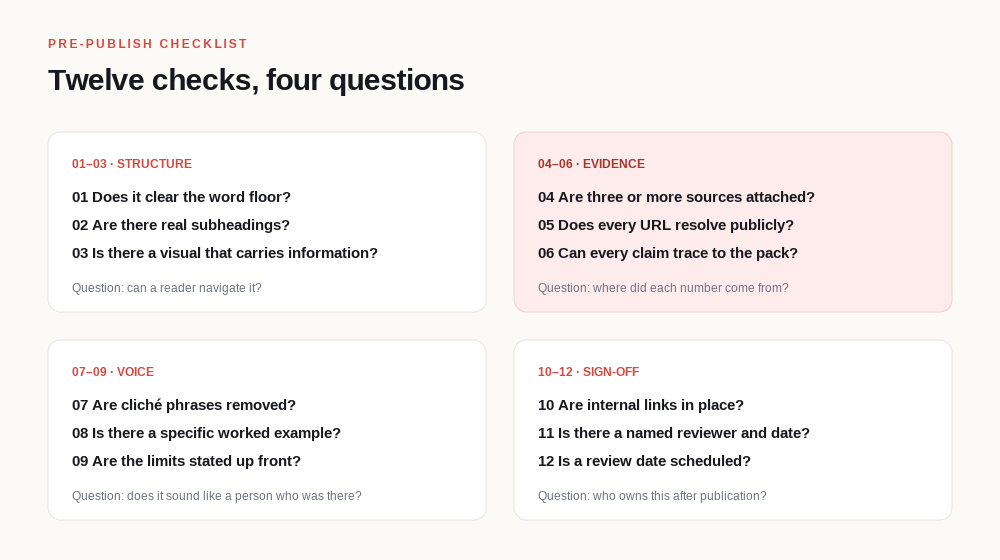
Twelve checks, four questions. Run them in this order so the cheap failures surface first.
#The AI content checklist
#Structure: can a reader navigate it?
1. Does it clear the word floor for its type? A supporting article may be 1,400 words; a pillar 2,500 or more. The number is a floor, not a goal. If a draft is half the floor, the argument is probably unfinished.
2. Are there real subheadings? At least four H2 or H3 headings that name decisions or questions. "Introduction," "Details," and "Conclusion" do not help a reader navigate.
3. Is there a visual that carries information? A diagram, chart, table, or annotated example — with a caption that says what the reader should notice. A stock photo of a laptop is decoration, not a visual aid.
#Evidence: where did each claim come from?
4. Are three or more public sources attached? Check that the sources exist, not only that the count is three. One authoritative source beats three thin ones, but three is the working minimum.
5. Does every source URL resolve? Open each link. Moved docs, 404s, and login walls all fail. A source a reader cannot reach is not a source.
6. Can every factual claim trace to the research pack? Pick the three most confident sentences in the draft and find their support. If a number appeared during drafting, send it back to research or delete it. Our research standard describes where evidence is allowed to come from.
#Voice: does it sound like a person who was there?
7. Are cliché phrases removed? Search for the stock vocabulary of generated prose: a time-stamping opener about today, a verb meaning to dig into a topic, a metaphor about changing everything, a claim about unlocking power, and a summary that gestures at the final day. If any survive, cut them.
8. Is there a specific worked example? A real number, a dated observation, a named step, or a failure mode. For example, "we tracked the median at 48 hours across six uploads" is specific; "we analyzed performance over time" is not.
9. Are the limits stated early? What can the reader not conclude from this evidence? If that sentence only appears in the last paragraph, move it up. Google's helpful content guidance is the external standard here.
#Sign-off: who owns this after publication?
10. Are internal links in place? At least three links to related pages on your own site, using the question as anchor text. An article with no internal links is an orphan, however good it is. Our cluster guide explains where those links should point.
11. Is there a named reviewer and a review date? "Editorial team" is not a name. A person read the final draft and signed off on the claims, and the date is recorded. Our editorial policy says what that responsibility means.
12. Is the next review scheduled? Forty-eight hours for a packaging read, 28 days for discovery, 90 days for the keep/refresh/merge/retire decision. Put it on a calendar with an owner, not in a document nobody opens.
#How to run it
Run the groups in order. Structure and evidence fail cheaply — a missing link or a thin draft is obvious in under a minute — while voice and sign-off need more thought. You do not want to spend ten minutes discussing tone on a piece with no sources.
The AI content checklist marks each check as pass, fail, or judgment. A fail is mechanical: the source URL is broken, the reviewer field is empty, the FAQ count is zero. A judgment is a human call: the worked example is technically present but dull, or the limits are stated but buried. In our own gate, mechanical fails block publication and judgments become warnings for the editor.
Run it once on the draft before review and once after the final edit. The second pass is the one that matters; the first pass tells the writer what to fix. If a check fails twice in a row across several drafts, automate it. That is how a good manual checklist turns into a reliable system.
We think the most valuable property of this list is its order. A reviewer who starts at check one will find the fixable problems before the debatable ones, and the conversation stays short.
#Five checks people skip
- Source URLs. The count looks right, so nobody opens the links. Open them.
- Limits. Everyone wants the claim; nobody wants the caveat. Put the caveat in the brief before drafting.
- The visual. A caption is not a diagram, and a screenshot without a point is not evidence.
- The reviewer name. Hard to fill in, easy to leave blank. A blank field means the piece is not ready.
- The next review date. Without one, the article starts decaying from its publication day.
In our experience, these five account for most of the problems that show up months later. None of them is interesting. All of them are cheap to fix now and expensive to fix after a reader asks where the number came from.
#The five-minute version
When a post has to go live in ten minutes, run a smaller set. It will not catch everything, but it catches the failures that are expensive to explain later.
- Open every source link. One broken URL is enough to stop the release.
- Read the first paragraph and the last paragraph. If they say the same thing, delete one.
- Find the one number in the piece. Point to the source that produced it.
- Check that a reviewer name and a review date exist.
- Verify the next review is on a calendar with an owner.
Five minutes, five checks. This is not the full list; it is the part you can still do when the day has gone wrong. In our experience, teams that run the short version under pressure are the same teams that eventually run the full version calmly, because the short version makes the missing fields impossible to ignore.
#FAQ
#How long does the AI content checklist take?
About twenty minutes for a drafted article. The structural and evidence checks take a few minutes each; voice and sign-off take longer because they require judgment. If it takes an hour, the draft was not ready for review.
#Should every check block publication?
No. Mechanical failures such as missing sources, broken URLs, or no named reviewer should block. Voice and specificity are judgment calls: a low readability score on a technical article may be correct. Treat them as warnings that a person must resolve.
#Can an AI run this checklist?
Most of it. Counts, URL validation, cliché detection, and field presence are deterministic and should be automated. The judgment checks — is the example real, are the limits adequate — need a human. Our quality control guide explains the split.
#What if a check fails right before publication?
Fix it or delay. A broken source URL or missing reviewer is not a cosmetic problem. If the piece was scheduled, return it to draft and clear the schedule so the failure is visible rather than retried overnight.
#How often should the checklist itself change?
Review it quarterly. If a check never fails, remove it. If a problem keeps reaching readers despite the checklist, add a check. A checklist that never changes is a document nobody reads, which is the problem we started with.
The point of a checklist is not to prove the team cares about quality. It is to make the cheap checks happen every time so the expensive attention can go where it is actually needed.
Sources
- Google Search Central: Creating helpful, reliable, people-first content
External standard for the limits and reader-value checks.
- Google Search Console: Performance report
A first-party signal used at the post-publication review.
- Google Search Central: FAQ structured data
Relevant to editorially approved FAQ sections after a substantive refresh.
Written and reviewed by Jean Cope for the ChannelWhisper editorial team. We may mention our own product in articles. Read our research method, disclosure, and corrections policy.
Ready to turn research into pipeline?
ChannelWhisper monitors competitor channels and generates ready-to-record briefs.
Keep reading
How to Refresh Old Content Without Rewriting It
A decision tree for old pages: keep, update, merge, rewrite in place, or retire — with the history and URLs worth preserving.
Topic Clusters for Small Content Teams
A pillar, six supporting articles, one intent per URL: how a two-person team builds topic clusters that actually get published.
How to Write a Content Brief That Writers Actually Use
A nine-field content brief template that fits on one page, plus the approval step that turns it into a contract instead of a form.