
How to QA AI-Assisted Content Before It Goes Live

Separate deterministic checks from editorial judgment, stop publication on real blockers, and keep the checks that catch problems without generating noise.

On this page
#A draft that sounds finished is the problem
A language model can produce a clean, structured article in under a minute. The headings are sensible, the transitions are smooth, and every paragraph sounds like someone who knows the subject. That fluency is exactly why AI content quality control has to be explicit: the draft no longer looks unfinished, so nobody feels the urge to check it.
The checkout-free feeling is the risk. A missing source, an invented statistic, or an unlabeled estimate reads the same as a verified claim when the sentences are equally confident. The only reliable defence is a gate that asks boring questions in the same order every time — and stops publication when the answers are wrong.
This guide separates the checks a machine can run from the judgments a human must make, explains why blockers and warnings need different treatment, and gives you a manual fallback if you have no automation yet.
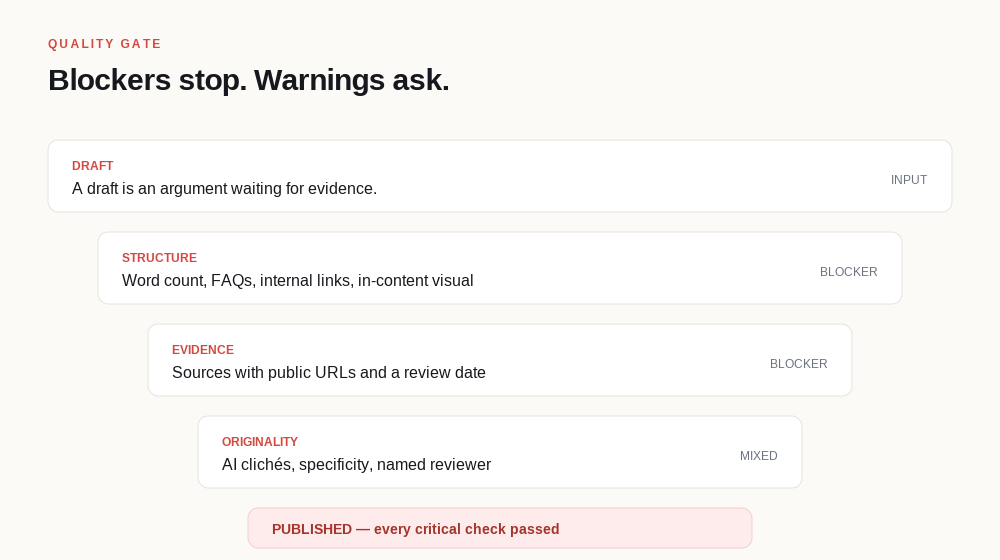
Blockers stop the release. Warnings ask a person to judge.
#What AI content quality control actually checks
Two layers, and they answer different questions.
Deterministic checks ask "is this present and valid?" They are fast, repeatable, and merciless about details. A missing source URL is missing whether the draft was written by a model, an intern, or the founder.
Editorial checks ask "is this true, useful, and ours?" They need context, taste, and a willingness to say no to a piece everyone already likes.
A system that only runs the first layer publishes confident nonsense with perfect metadata. A system that only runs the second layer relies on editorial heroics every afternoon. You need both, and you need to know which is which.
#The deterministic checklist
Group the checks so a failing draft tells you what kind of problem it has.
| Group | Checks | Why it matters |
|---|---|---|
| Identity | Title, slug, SEO title, meta description, focus keyword | Search and social listings need something specific to show |
| Structure | Word count by content type, subheadings, FAQ count, internal links | Thin pages and orphan pages are the most common low-value signals |
| Evidence | Three or more sources, every URL public and valid, review date | Claims without traceable sources cannot survive a correction request |
| Visuals | Featured image and at least one in-content diagram or example | A dense article with no visual aid is harder to use |
| Voice | AI-cliché phrases, specificity signals, editorial stage | Fluency without detail reads like filler |
| Ownership | Named reviewer, review date | Someone must be accountable for the claims |
Word count depends on the job: a short supporting article may be 1,400 words, a pillar 2,500 or more. The number itself is not quality; it is a cheap proxy for "did the piece develop the argument?" Treat it as a floor, not a target. Google's helpful content guidance makes the same point about substance over volume.
FAQ checks are not cosmetic either. A real FAQ answers the questions a reader still has after the main argument, and it can be marked up with FAQ structured data once an editor has approved the answers. A generated FAQ that restates the introduction adds nothing and should fail the editorial pass.
#The questions only a human should answer
Run these after the mechanical checks pass:
- Is the thesis actually argued, or just asserted? A confident first sentence is not an argument.
- Does every factual claim trace to a source in the pack? If a number appeared during drafting, send it back to research.
- Is the original insight real? A worked example, teardown, or defensible opinion is real. "We looked at the data" without data is not.
- Are the limits stated where a reader will see them? A caveat in the last paragraph does not repair an overclaim in the third.
- Would a skeptical reader learn anything? If the piece could be replaced by its own title, it should be.
- Is the voice consistent with the brief? Humor level, point of view, and the things the piece refuses to joke about were agreed before drafting.
- Is anything here we would refuse to correct publicly? If the answer is yes, the claim does not ship.
Our editorial policy and research method publish the same standard for readers. A quality gate is simply that policy made executable.
#Blockers and warnings are different tools
This distinction does more work than the length of the checklist.
A blocker is a failure with a correct answer. No source URL, no reviewer, no FAQ, fewer than three sources. The article does not publish, full stop. The editor fixes the field and runs the gate again.
A warning is a judgment call the machine should not make. Readability a little low, paragraph lengths uniform, specificity borderline. These deserve a human look, not an automatic rejection. Some of the best technical writing has a low readability score because the subject is genuinely difficult.
For example, a Flesch score below the target on a page about API quotas is a reason to read the page aloud, not to block it. A missing source URL on the same page is a reason to stop the release. Treating both as equally "failed" produces a gate that editors learn to ignore.
We think this is the most common design mistake in automated QA: making every check a blocker because blockers feel rigorous. A gate that cries wolf gets switched off, and then nothing is checked.
#Enforce it on every path
A gate that lives only in the editor is a suggestion. If a scheduled job, an API call, or a bulk import can change a post to "published," the same checks must run there too.
Three rules keep enforcement honest:
- One shared checker. The editor, the save endpoint, and the cron should call the same function. Duplicated logic drifts within a month.
- Structured failures. When the API refuses a publish, return the list of failed checks with the field names. "Publishing failed" sends the editor back to guesswork.
- Fail closed on schedules. A scheduled post that fails its gate should return to draft with its schedule cleared, not retry every night. The retry loop hides the problem and wastes a queue slot.
Store the result. A score, a check list, and a review date turn quality into something you can audit later. Six months after publication, when someone asks why a claim was made, the record should show what was checked and who signed off. Our content operations guide describes where this sits in the full pipeline.
#Tune the gate in report mode first
Do not switch on every blocker on day one. Run the checks in report mode against real drafts for a week and look at what they flag.
- A check that fires on every good draft is too strict or badly defined. Fix the check.
- A check that never fires is adding no information. Consider removing it.
- A warning that editors consistently act on may deserve to become a blocker.
- A blocker that editors consistently override is a sign the rule is wrong, not that the editors are careless.
The goal is a small set of checks that catch real problems without generating noise. Our own gate started broader and got narrower after the first few drafts. If you cannot explain why a check exists in one sentence, remove it.
#A twenty-minute manual pass
If you have no automation, run this by hand in the same order every time:
- Two minutes: title, slug, SEO title, meta description. Do they describe one specific piece?
- Three minutes: count sources and test every URL. Delete any claim with no source.
- Three minutes: count FAQs and internal links. Add what is missing.
- Five minutes: check the in-content visual and its caption. Does it carry information?
- Five minutes: search for cliché phrases and vague claims. Replace with numbers or remove.
- Two minutes: write the reviewer name and date. If you cannot name someone, do not publish.
Twenty minutes is cheap insurance. It is also a good way to discover which checks deserve to be automated once the team grows.
#FAQ
#What is AI content quality control?
It is the set of checks that runs on an AI-assisted draft before publication. Deterministic checks verify that sources, links, FAQs, visuals, and reviewer details exist. Editorial checks verify that the claims are true, the angle is original, and the limits are stated.
#Can automated checks replace a human editor?
No. A machine can verify that three sources are attached. It cannot tell whether those sources support the claim, whether the original insight is real, or whether an overclaim sits in the third paragraph. Automation handles the mechanical layer; a named person handles judgment.
#Which checks should block publication?
Block failures with a clear correct answer: missing or invalid source URLs, too few sources, no named reviewer, no review date, missing FAQs, and cliché-heavy prose. Leave readability, tone, and specificity as warnings so editors can apply context.
#How many sources does a draft need?
Three public, checkable sources is a workable minimum for most articles. Technical or contested claims need more. The count matters less than whether each source supports a specific statement and whether the article says what the sources cannot prove.
#What if a scheduled post fails the gate?
Return it to draft and clear the schedule. A nightly retry loop hides the failure and fills the queue. Tell the editor which checks failed, let them fix the draft, and set a new date when it passes.
A gate is not there to prove the team cares about quality. It is there so the team does not have to care on every single afternoon. Run the boring checks every time, keep the judgment human, and the drafts stop being a liability the moment they are generated.
Sources
- Google Search Central: Creating helpful, reliable, people-first content
External standard for substance and reader value.
- Google Search Central: FAQ structured data
Documents when and how approved FAQ content can be marked up.
- Google Search Console: Performance report
A first-party signal used in post-publication review, not in the pre-publish gate.
Written and reviewed by Jean Cope for the ChannelWhisper editorial team. We may mention our own product in articles. Read our research method, disclosure, and corrections policy.
Ready to turn research into pipeline?
ChannelWhisper monitors competitor channels and generates ready-to-record briefs.
Keep reading
AI Content Checklist: 12 Checks Before You Publish
A printable AI content checklist of twelve checks in four groups, with a one-minute test and a definition of good for each one.
How to Refresh Old Content Without Rewriting It
A decision tree for old pages: keep, update, merge, rewrite in place, or retire — with the history and URLs worth preserving.
Topic Clusters for Small Content Teams
A pillar, six supporting articles, one intent per URL: how a two-person team builds topic clusters that actually get published.