
Topic Clusters for Small Content Teams

A pillar, six supporting articles, one intent per URL: how a two-person team builds topic clusters that actually get published.

On this page
#Seven posts about seven things is not a strategy
A small content team publishes one article about keyword research, one about editing, one about AI tools, one about a customer story, and so on. The calendar looks busy. The site looks like seven unrelated blog posts with a shared logo, and search engines have no reason to treat it as an authority on anything. Topic clusters are the fix.
Topic clusters fix that by giving the work a shape. One page owns the broad topic; a small set of supporting pages answer the narrow questions around it; every page links to the parent and to a couple of siblings. For a small team, the benefit is not only rankings. It is that the next article becomes obvious, and the team stops arguing about what to write.
This guide is the version we use: three clusters, one pillar each, supporting articles with one intent apiece, and a coverage board that separates "planned" from "published." It works with two people and a spreadsheet.
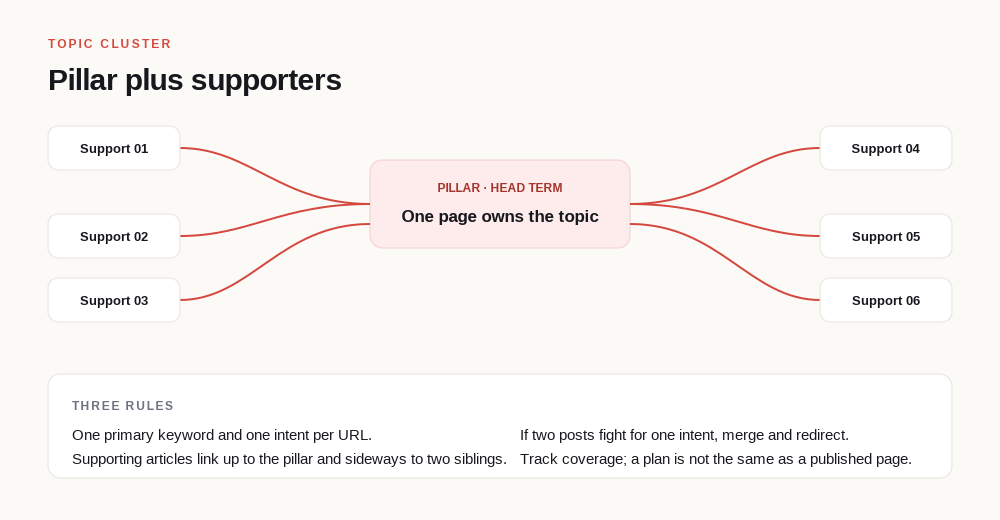
One page owns the head term. Supporting articles answer the long tail and link back.
#What topic clusters do for a small team
A cluster is a publishing structure with three rules:
- One pillar owns the head term. It is the broad, defensible answer that links to everything else in the cluster.
- Supporting articles own one long-tail question each. They link up to the pillar and sideways to two siblings.
- One primary keyword and one search intent per URL. If two pages fight for the same intent, merge them and redirect the weaker one.
The shape matters more than the volume. Six supporting articles around one well-chosen pillar create a body of work. Eighteen articles scattered across eighteen topics create a folder.
We think the biggest benefit is planning velocity. When a writer asks "what should I write next?", the answer comes from the cluster plan and the coverage gap — not from a fresh brainstorming session every Monday. Google's helpful content guidance is the external standard: a page should exist to help a reader with a real question, not to occupy a slot in a grid.
#Good topic clusters start with one to three, not ten
A small team cannot maintain ten clusters. Each one needs a pillar, six to eight supporting articles, internal links, and periodic refreshes. Overestimate your capacity and you get ten empty hubs.
Score candidate clusters from 1 to 5 on five questions:
| Criterion | The question |
|---|---|
| Product fit | Does this lead naturally to what we actually do? |
| Demand | Is there evidence of real questions rather than a volume estimate? |
| Winnability | Can a small site compete with the current results? |
| Originality | Do we have data, a teardown, or a distinct point of view? |
| Business value | Will this reach buyers, or only traffic? |
Two of those are gates, not points. If product fit or originality scores below 3, reject the cluster even if demand is high. A high-volume topic you cannot serve credibly is a trap with good metrics.
For example, our first cluster was "YouTube competitor intelligence for B2B": close to the product, supported by existing research, and specific enough to win. We seeded nine planned entries, published the pillar first, then worked through the supporting questions. A second cluster covered B2B YouTube strategy; a third covered AI content operations. Three clusters, 24 planned articles, one two-person team.
#Build the plan before the articles
Topic clusters are planned in a table, not a document with adjectives. Each row needs:
- Working title
- Intended URL slug
- Target keyword and intent
- Role: pillar or supporting
- Content type and target word count
- Status: planned, drafted, published, or dropped
That last field is the one teams forget, and it is why cluster plans become fiction. A published cluster is not the same as a planned one. Track coverage — how many of the planned entries actually exist — and make it visible. Our content operations guide treats that visibility as part of the publishing system.
For a two-person team, a realistic first 90 days is one pillar and six supporting articles: one deep piece and one shorter piece per week, with the other weeks reserved for research and review. The content calendar guide shows how to fit that into actual hours.
#Apply the cannibalization rules early
The most expensive cluster mistake is discovering two articles in the same cluster target the same search intent after both are published.
- One primary keyword per URL.
- One intent per URL: informational, commercial, or transactional.
- If a supporting keyword contains the pillar keyword verbatim, check whether it is really the same question in different words.
- If two entries collide, merge them into one stronger page and redirect the weaker URL.
For example, "youtube competitor analysis" and "youtube competitor analysis tool" can look different on a spreadsheet while fighting over one result. Decide which page owns the intent, give it the strongest answer, and make the other page a supporting link or drop it. Our consolidated evaluation guide exists because three overlapping comparison pages were quietly cannibalizing each other.
#Link the cluster together
Internal links are what turn a set of pages into a cluster:
- The pillar links to every supporting article, with descriptive anchor text.
- Every supporting article links up to the pillar.
- Every supporting article links to two siblings with a genuine reason — not a footer full of links.
- Links use the language of the question, not "click here."
A support page with no link to its pillar is an orphan wearing a cluster label. A pillar that never links to its supporters is a landing page with no depth. Both failures are invisible in a word count and obvious to a reader who tries to navigate the site.
#Review the cluster, not the article alone
Every month, answer four questions:
- Which planned entries are now published? What is the coverage percentage?
- Which entry is next, and does it have an approved brief?
- Do any keywords collide, or did a new post drift into another page's intent?
- Which published page is due for a refresh, merge, or retirement?
Write the answers down. A cluster plan that nobody reviews becomes a list of good intentions. Our topic clusters started with nine planned entries; tracking coverage is how we noticed which questions were genuinely answered and which were still sitting in the backlog.
If an entry has been planned for two quarters without a brief, either research it properly or drop it. A stale plan entry is a small daily tax on everyone's attention.
#Five mistakes small teams make
Too many clusters. Three well-fed clusters beat eight starving ones. Start with one if the team is small.
Pillars written last. The supporting articles have nowhere to link. Publish the pillar first, then the long tail.
Keyword lists instead of questions. A volume number is not a reader. Validate with calls, support, and search data before adding a row.
No status column. In our experience, this is the failure that makes every other cluster problem worse. The plan shows 24 articles and nobody notices that 14 are still planned. Coverage is the metric that matters.
Never merging. Two pages targeting the same intent do not become stronger together. Merge and redirect.
#FAQ
#How many clusters should a small team have?
Start with one, and add a second only when the first has a published pillar and at least four supporting articles. Three clusters is a healthy ceiling for a two-person team. A cluster you cannot maintain is worse than no cluster.
#How long should a pillar page be?
Long enough to own the topic honestly — usually 2,500 words or more — with links to every supporting article. Length is a proxy for coverage, not a goal. The pillar should answer the broad question well enough that a reader rarely needs another site.
#Can two clusters share a supporting article?
Technically yes, but it usually means the clusters are not distinct enough. If the same article genuinely serves both, check whether one of the clusters should be merged into the other. Clarity beats coverage.
#How often should a cluster be reviewed?
Monthly for coverage and collisions, quarterly for content quality. At the quarterly review, every published page gets one of four outcomes: keep, refresh, merge, or retire. Write the reason down so the next review can learn from it.
#What if a planned article turns out to be a bad idea?
Drop it. Record the reason in the plan so nobody re-adds it next quarter. A cluster plan is a working document, not a promise to produce every row. Removing a weak candidate is a decision, not a failure.
Topic clusters are a way of making the next decision easier. Build fewer of them than you think you need, fill them in public, and let the coverage numbers tell you what is real.
Sources
- Google Search Central: Creating helpful, reliable, people-first content
External standard for whether a page answers a real reader question.
- Google Search Console: Performance report
A first-party signal for validating candidate questions.
- Google Search Central: FAQ structured data
Documents markup for editorially approved FAQ content on supporting pages.
Written and reviewed by Jean Cope for the ChannelWhisper editorial team. We may mention our own product in articles. Read our research method, disclosure, and corrections policy.
Ready to turn research into pipeline?
ChannelWhisper monitors competitor channels and generates ready-to-record briefs.
Keep reading
AI Content Checklist: 12 Checks Before You Publish
A printable AI content checklist of twelve checks in four groups, with a one-minute test and a definition of good for each one.
How to Refresh Old Content Without Rewriting It
A decision tree for old pages: keep, update, merge, rewrite in place, or retire — with the history and URLs worth preserving.
How to Write a Content Brief That Writers Actually Use
A nine-field content brief template that fits on one page, plus the approval step that turns it into a contract instead of a form.