
AI-Assisted Content Operations: A Practical System

A seven-stage workflow for AI-assisted content: validate demand, research, approve a brief, draft, QA, enforce a publish gate, then refresh.

On this page
#The generator was never the hard part
Every team that tries "AI content at scale" discovers the same thing in week three: generating drafts is easy, and defending them is not. The folder fills up. The drafts are fluent, structured, and almost impossible to tell apart. Nobody can say which claims are sourced, who approved them, or what decision any of it changed. That is the problem AI content operations exists to solve.
The missing piece is not a better model. It is a system. AI content operations is the set of stages, gates, and ownership rules that turn a reader question into an asset a human can stand behind — and keep it correct after publication. The model is one step in that system, and it is not the step that carries the risk.
This guide describes a seven-stage pipeline we use on this blog: demand validation, research, approved brief, draft, quality check, publish gate, and measurement with refresh. Two of those stages require a named human. Everything else can be assisted, automated, or templated. That distinction is the whole design.
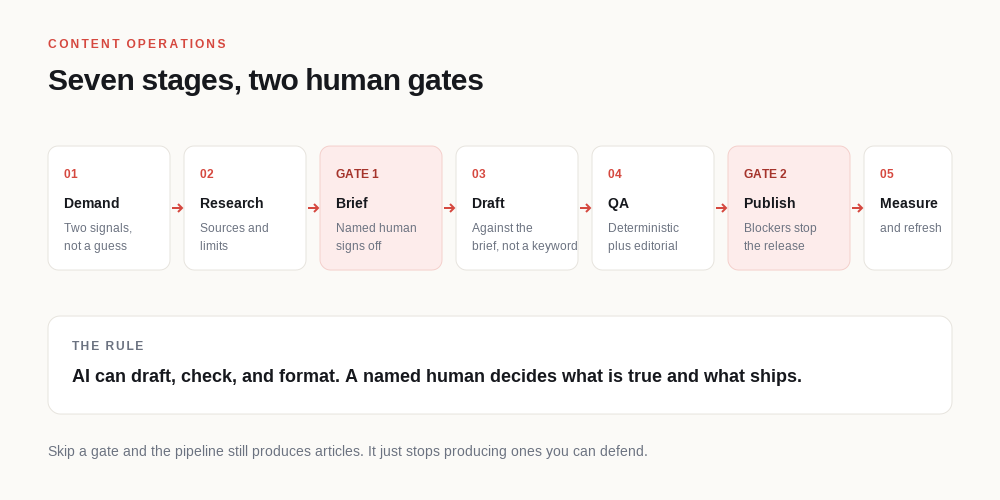
Seven stages, two human gates. Skip a gate and the pipeline still produces articles — just not ones you can defend.
#What AI content operations actually means
It is tempting to define the field by the tool: "we use a model to write articles." That is a tactic, and a fragile one. Models change, prompts drift, and a workflow built around a single vendor's interface breaks when the interface changes.
A better definition is operational: AI content operations is the repeatable path from a validated question to a maintained answer, with explicit evidence at every step. The path has inputs (questions, sources, customer evidence), transformations (brief, draft, check), gates (human approval), and outputs (a published page with a review date and an owner). Tooling sits inside that path and can be replaced.
Three principles make it work:
- No article without a brief. A brief is a decision document, not an outline. It names the reader, the question, the evidence, and what the piece will not claim.
- No publish without a gate. The check must run in the same place on every path — editor, API, and scheduled job — or it will be bypassed on the busiest week.
- No ownership without a name. Every published piece has a reviewer and a review date. If nobody can be named, the piece is not ready.
Google's helpful content guidance is a useful external standard: a page should exist to help a reader, not to satisfy a calendar. The operational rules above are how a small team makes that standard enforceable on a Tuesday afternoon.
#Stage 1: Validate demand with two signals
The first failure is writing about a topic because a keyword tool reported volume. A number is not a question, and volume is not evidence that your buyer cares.
Use at least two independent signals:
- Internal: a question repeated in sales calls, support tickets, onboarding, or churn interviews.
- Search: queries in Search Console for your own site. This shows what you were visible for, not the total market.
- Public: competitor titles, dates, and formats from documented APIs. Public data reveals what was published, not why it worked.
- Community: the same unanswered question in a forum, Slack group, or comment thread.
If all your signals come from the same source — especially a single keyword estimate — you have one signal with formatting. Put the idea back in the research queue. This stage is deliberately cheap. It is much less expensive to reject a candidate here than after drafting.
We think this stage is where most small teams should spend more time, not less. It is the only stage where a bad decision costs almost nothing.
#Stage 2: Build a research pack before the brief
A research pack is the evidence a brief will cite. Keep it small and specific:
- Sources with public URLs. Official docs, primary research, or pages you can quote accurately. Three is a workable minimum.
- Original evidence. A teardown, an internal test, a worked example with real numbers, or a documented observation. This is what makes the piece yours.
- Limits. What the data cannot show. Good AI content operations treats the research pack as the evidence boundary. A pack that only records what supports the thesis is advocacy, not research.
- Visual plan. Which diagram, table, or annotated example will carry the explanation.
One rule prevents most trouble here: do not claim a number you did not measure. If live SERP data is unavailable, say so in the pack and make no volume claim in the article. If a competitor's private analytics are unavailable — and they always are through public data — do not invent a plausible figure. The research pack is the place where a tempting sentence gets stopped before it reaches a reader.
#Stage 3: Approve the brief before drafting
The brief is the contract between research and drafting. It fits on one page and includes the audience, the question, the promise, the thesis, the outline, the evidence, the limits, the original insight, the internal links, and the success metric. It ends with a name and a date.
Approval is a human act. A model can complete the fields; it cannot be accountable for them. In our workflow, a brief is only ready when every required field is complete, at least three public sources are attached, internal links are planned, and a named editor has approved it. Validation of those fields is deterministic, so the editor is not asked to check box-ticking. The editor is asked to judge the argument.
This gate is unpopular because it adds a meeting before the fun part. It is also the reason the draft does not wander. A writer who opens a complete brief does not have to invent the audience, the angle, or the boundaries. Our brief workflow shows the one-page format in practice.
#Stage 4: Draft against the brief
This is where the model belongs. Given a complete brief, a model can produce a competent first draft quickly: structure, transitions, examples, and a FAQ section. That is genuinely useful work.
What it cannot do is decide what is true. Two rules keep the draft honest:
- Every factual claim must trace to the research pack. If a sentence needs a source the pack does not have, the sentence goes back to research or out of the draft.
- Voice is a set of constraints, not a vibe. Define humor level, banned openers, and the point of view the piece is allowed to have. "Make it engaging" is not an instruction a model can follow consistently. "Lead with the decision, use one dry aside per section, never joke about a customer" is.
The output of this stage should be treated as a draft, never as a publishable article. The moment a team skips review because "the model already checked it," the system has failed.
#Stage 5: Run two kinds of QA
Quality checks come in two flavors, and conflating them is a common mistake.
Deterministic checks answer yes-or-no questions: word count, source count, source URLs, internal links, FAQ count, featured image, in-content visual, named reviewer, review date, AI clichés, SEO score. A machine can run these in milliseconds and never gets tired.
Editorial checks answer judgment questions: Is the thesis actually argued? Is the original insight real or a restatement? Does the piece say something untrue in a fluent way? Are the limits stated where a reader will see them? These need a person.
A good editorial policy makes the same split in prose: deterministic failures stop the release, judgment calls get a conversation. Tests we wrote for our own quality gate distinguish blockers from warnings. A missing source URL is a blocker: the article does not publish. A slightly low readability score is a warning: a human decides. That split matters because a gate that blocks everything gets disabled, and a gate that blocks nothing is theatre.
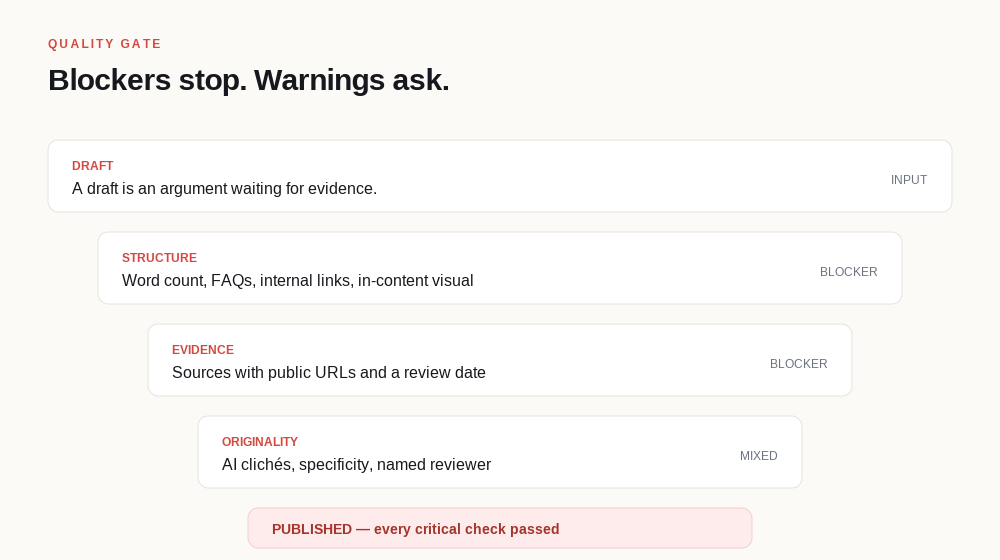
Blockers stop the release. Warnings ask a human to judge.
#Stage 6: Enforce the publish gate everywhere
A gate that lives only in the editor is a suggestion. The same rule must run wherever a post can become public: the admin editor, the save API, and the scheduled-publish job. Our implementation returns a structured error listing the failed checks when an API tries to publish a blocked post, and scheduled posts that fail are returned to draft with their schedule cleared rather than retried forever.
That last detail is easy to miss. A scheduled post that fails its gate every night will either publish anyway or hammer the queue. Failing closed and clearing the schedule makes the problem visible. It also gives the editor a clear action: fix the blocker, set a new date.
The gate should record its result. A stored score, a review date, and the check outcomes turn quality into something you can audit later. When a reader challenges a claim six months after publication, the record shows what was checked and who signed off.
#Stage 7: Measure, refresh, and retire
Publication is the midpoint of the pipeline, not the end. Give each piece a cadence:
- 48 hours: a directional read. Was it found and clicked?
- 7 days: decide whether a follow-up is justified.
- 28 days: look for durable search traffic and returning readers.
- 90 days: review the portfolio. Repeat, change, refresh, or retire.
A content operations system without a retirement path produces a library that grows more slowly than its own decay. At the 90-day review, every piece gets one of four outcomes: keep, refresh, merge, or retire. Write the reason down.
This is also where clustering pays off. A pillar page owns the head term; supporting articles own the long tail and link back. When one supporting article stops earning its place, the cluster structure tells you whether to merge it into a sibling or let the pillar cover the question. Our cluster and calendar workflow covers the scheduling side.
#What to automate and what to keep
| Work | Automate? | Why |
|---|---|---|
| Source URL validation | Yes | Deterministic, boring, error-prone by hand |
| Draft generation | Yes, as a first draft | Fast, but never publishable without review |
| Gate checks | Yes, in every publish path | Consistency matters more than cleverness |
| Scheduled publishing | Yes, with fail-closed behavior | Removes a recurring manual task |
| Demand validation | No | Needs context from calls and support |
| Brief approval | No | Requires a named person accountable for the argument |
| Final editorial judgment | No | Fluency is not truth |
| Refresh decisions | No | Needs a view of the whole portfolio |
The pattern is simple: automate the work that has a correct answer, keep the work that requires judgment. Most automation projects fail by inverting this — they delegate judgment and keep the mechanical tasks manual.
#The roles, in a team of two
You do not need an editorial department. You need three roles, which two people can cover as long as they do not review their own work.
| Role | Owns | Time per article |
|---|---|---|
| Researcher | Demand signals, sources, research pack | 45–60 minutes |
| Editor | Brief approval and final sign-off | 20–30 minutes |
| Owner | Schedule, gate result, refresh date | 10 minutes |
For example, a two-person team can have one person research and draft while the other approves the brief and signs off the draft, then swap roles on the next piece. What does not work is one person approving their own brief. The approval loses its value the moment the same person holds both pens.
In our experience, the role that disappears first is the owner — the person who watches the review dates. It is also the role that prevents the library from decaying. Put the 28-day and 90-day reviews on a calendar with a name attached, not in a document nobody opens.
We think team size matters less than separation of roles. A five-person team with no named reviewer has a weaker system than two people who alternate gates and keep a written decision log.
#A 30-day rollout
| Week | Work | Output |
|---|---|---|
| 1 | Write the brief template and the source standard | One page, three required sources |
| 2 | Add deterministic checks and run them in dry-run mode | A report, not a blocker yet |
| 3 | Turn the checks into a real gate on every publish path | Blockers enforced, warnings visible |
| 4 | Publish two pieces end to end; review the gate itself | A tuned checklist and a named reviewer |
Do not switch on every blocker in week one. Run the checks in report mode first, see what they flag on real drafts, and remove the checks that produce noise. A gate with three false alarms becomes a gate nobody reads.
#FAQ
#What is AI content operations?
It is the workflow that turns a reader question into a reviewed, maintained article: demand validation, research, an approved brief, drafting, QA, a publish gate, and a refresh cadence. The AI model is one step in that workflow, not the workflow itself.
#Can AI write articles without human review?
It can produce text, but it cannot be accountable for claims. A named person must approve the brief and sign off on the final piece. Without that, the site has no answer when a reader asks where a number came from.
#What should a publish gate block?
Block deterministic failures: missing sources, invalid source URLs, too few internal links or FAQs, no named reviewer, no review date, and cliché-heavy prose. Leave judgment calls — readability, tone, specificity — as warnings for a human editor.
#How many sources does an AI-assisted article need?
Three public, checkable sources is a workable minimum for most articles, with more for technical or contested claims. The count matters less than whether each source supports a specific claim in the piece and whether the limits are stated.
#How often should published content be refreshed?
Give every piece a 48-hour, 7-day, 28-day, and 90-day check. Anything tied to a product, interface, or policy needs a scheduled refresh at publication. At 90 days, decide explicitly: keep, refresh, merge, or retire.
#What should we never automate?
Demand validation from customer evidence, brief approval, final editorial judgment, and retirement decisions. These require context and accountability. Automating them removes the exact work that makes content trustworthy.
AI content operations is not a prompt with a logo. It is a set of stages where the risk is visible, the checks are consistent, and a named human is accountable at the two moments that matter. Get that right and the model becomes useful. Get it wrong and you have a very fast way to fill a folder.
Sources
- Google Search Central: Creating helpful, reliable, people-first content
External standard for whether a page helps a reader or exists to fill a calendar.
- Google Search Console: Performance report
A first-party demand signal used in the validation stage.
- Google Search Central: FAQ structured data
Documents how FAQ content can be marked up once it has been editorially approved.
Written and reviewed by Jean Cope for the ChannelWhisper editorial team. We may mention our own product in articles. Read our research method, disclosure, and corrections policy.
Ready to turn research into pipeline?
ChannelWhisper monitors competitor channels and generates ready-to-record briefs.
Keep reading
AI Content Checklist: 12 Checks Before You Publish
A printable AI content checklist of twelve checks in four groups, with a one-minute test and a definition of good for each one.
How to Refresh Old Content Without Rewriting It
A decision tree for old pages: keep, update, merge, rewrite in place, or retire — with the history and URLs worth preserving.
Topic Clusters for Small Content Teams
A pillar, six supporting articles, one intent per URL: how a two-person team builds topic clusters that actually get published.