
We Tried to Automate Our Blog. Here Is What Broke

Five things that broke when we automated our content pipeline — migration history, auth scope, thin drafts, tool overclaims, and ownership — and what we changed.

On this page
#The pipeline worked perfectly. That was the problem.
We rebuilt our blog with automation in the loop: drafts generated from briefs, quality checks before publication, scheduled posts, a cluster board, a sitemap that updates itself. The pipeline ran. Articles appeared on time. Every dashboard was green. AI blog automation had never looked healthier.
Then an AdSense application came back with the one phrase nobody wants to read: low value content. AI blog automation had delivered exactly what it promised, which turned out to be the problem.
What followed was a month of finding out where the automation had been confidently wrong. None of the failures were in the model. They were in the assumptions around it — the database, the auth layer, the definition of "good enough," and the question of who was actually responsible. If you are about to automate your own blog, this is the post we wish we had read first.
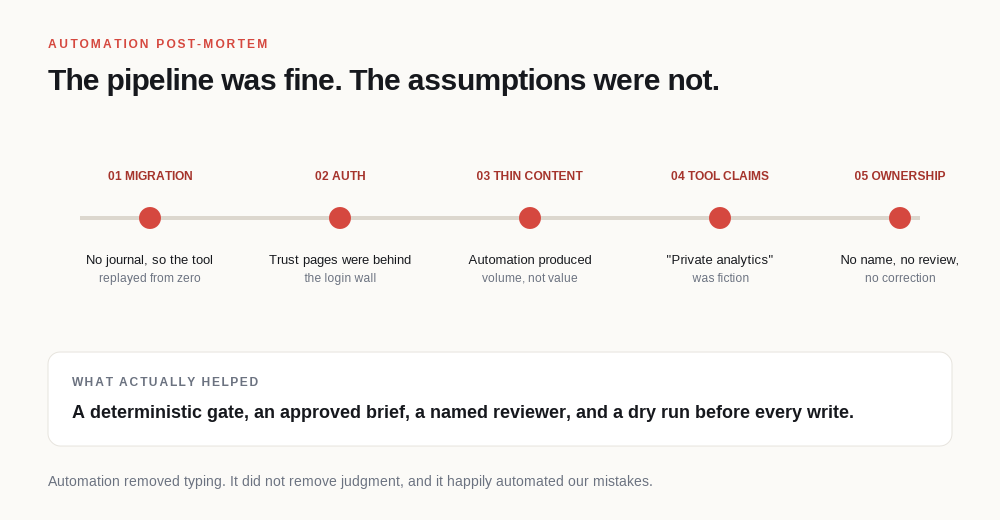
The pipeline was fine. The assumptions around it were not.
#What AI blog automation broke first
#1. The migration tried to time travel
Our schema had been built with db:push, which means there was no migration journal. When we asked the standard migration tool to apply a reviewed change, it looked at an empty history, decided every migration since the beginning needed to run, and rolled the whole thing back.
The fix was old-fashioned: read the reviewed SQL, split it into statements, and apply it in a transaction with a dry run first. The automation did not fail to be clever. It was clever about the wrong situation. Drizzle's migration docs explain the journal model; the lesson is to know whether yours exists before you trust a one-word command.
That is the first rule of AI blog automation we now keep: dry run, read the statements, then apply. It takes ten extra seconds and has saved us twice.
#2. The trust pages were invisible
A session gate in Next.js proxy redirected every path it did not recognize to sign-in. That is a sensible default for an application. It is a disaster for a publication: our contact page, editorial policy, disclosure, corrections page, and research method were all behind a login wall.
We found this while checking public routes, not by looking at a dashboard. Everything "worked" — the pages existed, they rendered, and signed-in users could see them. An automated content pipeline has no opinion about whether a page is reachable by readers. It will happily publish articles linked to a trust page that nobody can open.
For example, a reader trying to check our corrections policy would have been asked to create an account. That is not a trust signal. Every public path is now listed explicitly and tested without a session.
#3. The drafts were fluent and thin
This was the big one. The model produced five-hundred-word articles that read perfectly and said almost nothing. They had headings, transitions, and a confident conclusion. They also had no sources, no reviewer, and no point of view. Under automation, that kind of output scales beautifully — which is exactly the problem.
We retired or consolidated the worst pages, preserved the originals as drafts with redirects, and rewrote the survivors to two thousand words or more with sources, FAQs, diagrams, and a named reviewer. Then we wrote the gate that would have stopped them in the first place. Our quality control guide describes the checks; the short version is that blockers stop publication and warnings ask a human.
In our experience, "the draft sounds good" is the least reliable signal in the entire workflow. Fluency is cheap now. Evidence is not.
#4. The tools promised things that are impossible
Several competitor-research tools describe their output in language that implies access to another channel's private analytics. It is a compelling story and it is not true through public data. Impressions, retention, and traffic sources require authorization from the channel owner.
Our own early comparison copy flirted with the same implication. We rewrote it to say plainly what public fields expose and what they cannot, and made that distinction the spine of the evaluation guide. Automation will reproduce a misleading claim as faithfully as a true one, and it will do it in every article that touches the topic. A single wrong assumption in a source document becomes a site-wide position.
#5. Nobody was accountable
A generated draft has no author. That sounds like a small philosophical point until a reader challenges a claim and you need a name. The original posts had no reviewer, no review date, and no owner for corrections.
The fix was structural: every article now carries a named reviewer and a date, and the gate refuses to publish without them. The byline links to a real editorial policy that says what a reviewer is responsible for. We did not solve accountability by writing a value statement. We solved it by making the field mandatory.
#The smaller failures that kept us honest
A few things broke quietly:
- The transaction pooler timed out on one-off scripts. Session-mode connections worked. Nothing was wrong with the data; the connection path was the problem.
- A gap-pitch cron could have drafted public articles from customer analysis. We disabled it by default. Private customer context does not become a blog topic because a pipeline exists.
- Scheduled posts that failed a check would have retried forever. They now return to draft with the schedule cleared, so the failure is visible.
- Thin topic archives were being indexed. They are now
noindex, and the sitemap only includes hubs with enough posts to stand on their own.
None of these is dramatic. All of them are the kind of thing a green dashboard will not tell you.
#What actually helped
Five changes did more for quality than any prompt. We think the dry run is the most underrated of the five:
- An approved brief before drafting. If the argument is not settled on one page, the draft invents it.
- A shared gate on every publish path. Editor, API, and scheduled job call the same checker. A gate in one place is a suggestion.
- A dry run before any write. Database changes, bulk edits, and redirects all get a preview.
- Named ownership. Reviewer, review date, and a 90-day decision to keep, refresh, merge, or retire.
- A public-route smoke test. Check the site as a stranger, not as an admin with a session.
Our content operations guide turns these into a seven-stage pipeline. The model sits in one stage. The gates and the ownership rules carry the rest.
#What we would not automate again
We would not automate brief approval, final editorial judgment, demand validation from customer evidence, or retirement decisions. Those are the moments where someone has to say "this is true," "this is ours," or "this no longer belongs." A pipeline can prepare those decisions and record them. It cannot make them.
We also would not automate the first version of anything that touches production infrastructure. Read the SQL. Open the page in a clean browser session. Ask whether the tool's claim is actually possible. The ten minutes you spend being suspicious is the whole advantage of being human.
#FAQ
#Did AI write the low-value posts?
It helped draft them. The failure was ours: we let a fluent draft count as a finished article. The model did what models do. The missing piece was a brief, a gate, and a reviewer.
#What should never be automated in a content pipeline?
Brief approval, final editorial judgment, demand validation from customer evidence, and the decision to retire a page. These need context and accountability. Everything with a verifiable correct answer — source URLs, FAQ counts, link checks — is a good automation candidate.
#How do you stop thin content at scale?
Define a floor by content type and enforce it on every publish path. Word count alone is not quality, but a minimum catches the most common failure: a five-hundred-word draft that restates its own title. Pair it with source, FAQ, visual, and reviewer checks.
#What is a publish gate?
A deterministic check that runs before an article becomes public. It blocks fixable failures such as missing sources, invalid URLs, no internal links, or no named reviewer. Judgment calls are warnings for a human editor. Our quality guide breaks down the split.
#Would we automate the blog again?
Yes, but in the other order. Build the brief, the gate, and the ownership rules first. Then let the model draft against them. Automation is excellent at executing a good system and outstanding at scaling a bad one.
The lesson about AI blog automation is not "do not automate." It is that automation inherits your assumptions and runs them faster. Fix the assumptions first, and the pipeline becomes useful. Skip that step, and it becomes a very efficient way to publish things nobody can defend.
Sources
- Drizzle ORM: Migrations
Documents the migration journal model that caused the replay failure.
- Next.js: proxy file convention
Documents the routing layer where public paths must be declared.
- Google Search Central: Creating helpful, reliable, people-first content
External standard that the thin drafts failed.
Written and reviewed by Jean Cope for the ChannelWhisper editorial team. We may mention our own product in articles. Read our research method, disclosure, and corrections policy.
Ready to turn research into pipeline?
ChannelWhisper monitors competitor channels and generates ready-to-record briefs.
Keep reading
AI Content Checklist: 12 Checks Before You Publish
A printable AI content checklist of twelve checks in four groups, with a one-minute test and a definition of good for each one.
How to Refresh Old Content Without Rewriting It
A decision tree for old pages: keep, update, merge, rewrite in place, or retire — with the history and URLs worth preserving.
Topic Clusters for Small Content Teams
A pillar, six supporting articles, one intent per URL: how a two-person team builds topic clusters that actually get published.