
How to Measure YouTube Impact on Pipeline

A confidence ladder for YouTube pipeline attribution: UTMs, buyer self-reports, CRM history, and small tests — with the language each one earns.

On this page
#The question nobody can answer exactly
Somewhere in every revenue meeting, someone asks for a report that maps YouTube views directly to closed deals. The request is reasonable. The report does not exist in any honest form. YouTube pipeline attribution does not work that way.
YouTube can tell you what happened on YouTube: impressions, clicks, watch time, and the search terms that brought viewers to your videos. Your CRM can tell you what happened in deals. It cannot tell you which video caused a buyer to pick up the phone three weeks later. Between those two systems sits a gap that people fill with confidence and very little evidence.
The useful version of the question is smaller: what can we prove, how strongly can we prove it, and what should we do with the answer? YouTube pipeline attribution is a confidence exercise, not a dashboard. This guide gives you a ladder of evidence, a measurement setup you can build in an afternoon, and the language each rung entitles you to use.
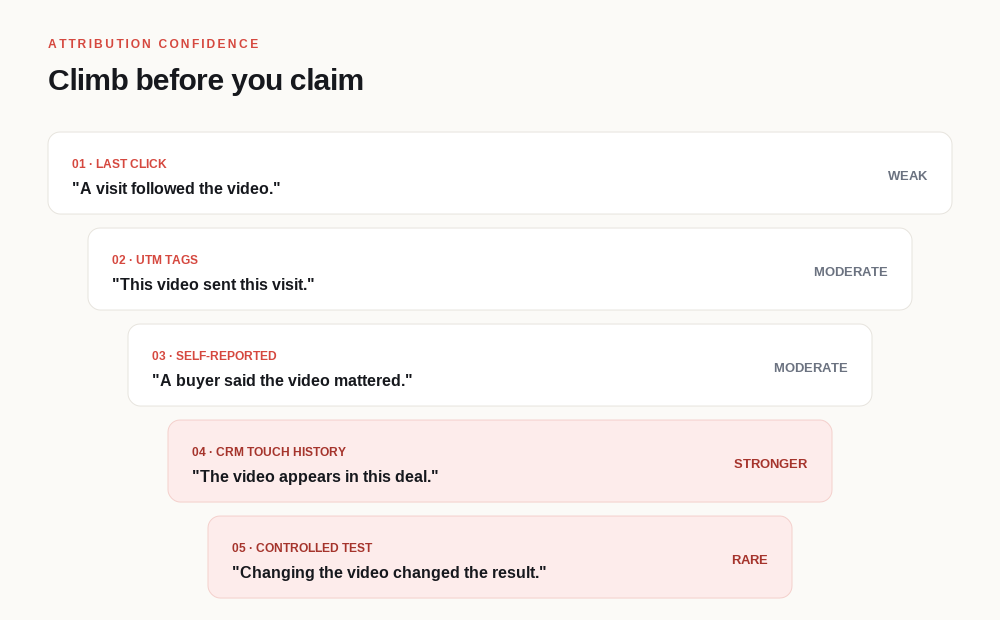
Climb the ladder before you write the sentence "YouTube caused this deal."
#Why the last-click report lies
A last-click report says that a visitor arrived from a YouTube link and then converted. That is true and nearly useless. The same buyer may have watched four videos, read two articles, asked a colleague, and been retargeted by an ad. The last click is simply the final event in a sequence you did not measure.
The opposite error is just as common. A deal closes and the rep remembers that someone watched a video, so the deal gets tagged "YouTube." Memory is not instrumentation. Both errors produce the same outcome: a number that looks authoritative and collapses under one question.
For the metrics YouTube itself provides, the boundary is clear. Public data exposes titles, dates, and public view counts through the Data API. Authorized reports add impressions, click-through rate, and retention through the Analytics API. Neither report contains your CRM's opportunities. Any tool that claims to join them is doing modelling, not measuring.
#The YouTube pipeline attribution ladder
Read the ladder from the bottom up. Each rung supports a stronger sentence, and none of the top rungs is available to most small teams.
Rung 1: last click. A visit came from YouTube and converted. You may say: "A conversion followed a YouTube visit." You may not say the video caused it.
Rung 2: UTM-tagged links. You tagged the link in each video's description, so you know which video sent the visit. You may say: "This video sent 40 visits, and three converted." You still cannot say the video created the intent.
Rung 3: self-reported attribution. A form asks "How did you first hear about us?" and a buyer types "your video about migration." You may say: "Buyers mention this video when asked." Self-reported data is fuzzy but it captures something clicks cannot: the buyer's own memory of what mattered.
Rung 4: CRM touch history. Your reps record which assets they sent, and the video appears in the deal's history before the close. Now you can say: "This video was present in six deals that closed." Presence is not cause, but it is a real pattern across time.
Rung 5: a controlled test. You change one variable — publishing a format, pausing a series — and observe a change in a defined outcome. This is the only rung that supports "changing this changed the result." It is also the one almost nobody runs, because B2B samples are small and channels are slow.
Most teams live on rungs two through four. That is fine. A defensible claim at rung three is worth more than a fake causal claim at rung five.
#Build the measurement setup in an afternoon
This YouTube pipeline attribution setup does not need a data warehouse. It needs consistent conventions that survive staff changes. Put them in your publishing checklist so they are followed on a busy week — the content calendar guide shows where that checklist lives.
Tag every link. For example, use a UTM scheme with fixed values: utm_source=youtube, utm_medium=video, and utm_campaign=<slug>. Put the video slug in the campaign field, not a friendly title. A naming scheme nobody follows is worse than none, so make it the default in your publishing checklist.
| Field | Value | Why |
|---|---|---|
utm_source | youtube | Constant across all videos |
utm_medium | video | Distinguishes from email and organic search |
utm_campaign | breakout-video-first-48-hours | The exact asset, traceable later |
utm_content | description or pinned-comment | Which placement worked |
Give each video one destination. A video that says "learn more" and links to a generic homepage produces an unreadable report. Link to the page that continues the decision: a comparison, a checklist, a doc. Our strategy guide covers how to choose that next step.
Ask one question on the demo form. "How did you first hear about us?" with a free-text field is enough. Do not make it required if it hurts conversion; a voluntary answer is still a signal. Review the answers monthly and write down the exact words buyers use.
Make it easy for sales to record touches. Add a single custom field or a saved note template: "assets shared." If reps have to fill in five fields, they will not. If they can paste a video URL into one box, some of them will.
Keep a search-side signal. Search visibility is a parallel path to pipeline. Search Console shows the queries that brought people to your site. For a fuller view of the decision ladder these numbers support, see the SaaS growth guide and the analytics guide.
#Write claims at the right confidence
The output of YouTube pipeline attribution is not a number. It is a sentence that matches the evidence.
| Evidence you have | Sentence you may write |
|---|---|
| Views and a conversion in the same week | "Activity increased alongside conversions" |
| UTMs on video links | "This video sent 40 visits; three converted" |
| Buyers naming the video on a form | "Buyers mention this video when asked" |
| Video in six closed-deal histories | "This video appears in six closed deals" |
| A pause-and-resume test with a clear change | "Pausing this format reduced qualified demos by X" |
Notice that the first four sentences are all useful. None of them requires pretending to have causal proof. Teams get into trouble not because their data is weak but because their verbs are too strong. "Caused," "drove," and "generated" should be reserved for the top rung.
We think the most valuable report is a one-page quarterly note: three videos with strong signals, the evidence for each, the claim written at the correct confidence, and one decision to repeat or stop. A note like that survives a skeptical CFO. A dashboard of attribution percentages does not.
#A holdout test, if you can run one
If you must make a causal claim, design a small test before you look at the results.
Pick one format — say, short implementation clips — and pause it for four weeks. In our experience, the pause is the easy part; deciding what to compare is not. Keep everything else as stable as possible. Choose the outcome in advance: qualified demo requests from tagged links, or the number of deals whose history includes that asset. Record the baseline from the previous eight weeks.
Then compare. If the outcome falls during the pause and returns when you resume, you have a signal, not proof. A single test with a small sample is still weak; the value is that you know exactly what it is worth. Do not starve a channel for a quarter to chase statistical significance. The channel is a long-term asset, and a test that damages it has a cost the spreadsheet will not show.
#Five mistakes to avoid
Treating a tagged click as a cause. A click is a path, not a motive. Use path language.
Skipping the form question because the data is messy. Messy self-reported answers still contain buyer language you cannot get anywhere else.
Reporting percentages without denominators. "30% of conversions came from YouTube" means nothing without the time window, the tracking method, and the total.
Changing UTM conventions mid-quarter. Your history becomes incomparable. If you must change, document the date and keep the old values readable.
Letting the tool define the claim. A vendor's attribution model is a model. It can be useful, but it does not turn rung two evidence into rung five certainty.
#FAQ
#Can YouTube be tied to pipeline at all?
Directionally, yes. You can connect tagged video visits, buyer self-reports, CRM touch history, and controlled tests into a credible picture. You cannot get a clean causal number from platform data alone. State the strength of each signal and make decisions from the pattern.
#What is the best attribution model for YouTube?
For most B2B teams, a simple multi-signal view beats a sophisticated model. Use UTMs for paths, self-reported answers for buyer memory, and CRM history for presence in deals. A model that hides its inputs is harder to defend than three imperfect signals you can explain.
#How should I tag links in YouTube descriptions?
Use a fixed scheme: utm_source=youtube, utm_medium=video, and utm_campaign=<the-video-slug>. Add utm_content if you use more than one placement. Put the scheme in your publishing checklist so every video follows it.
#How long before YouTube influences pipeline?
Expect a quarter to learn and longer to compound. B2B buying cycles are slow, and search-driven videos keep working months after publication. Judge a program on a body of work and a consistent measurement method, not a single deal.
#What if sales never records video touches?
Make it nearly effortless. One custom field, a saved note, or a shared list of asset URLs will get some adoption. If reps still will not do it, rely on UTMs and self-reported answers and say plainly that CRM history is incomplete. Do not invent the missing data.
YouTube pipeline attribution is not a reporting problem. It is a language problem. Collect the signals you can, climb as high as the evidence allows, and describe what happened with verbs the data can carry.
Sources
- YouTube Data API: video resource
Documents the public fields available outside YouTube Analytics.
- YouTube Analytics API: reports.query
Documents the authorized metrics available for your own channel.
- Google Search Console: Performance report
Provides a parallel search-side signal for your own site.
Written and reviewed by Jean Cope for the ChannelWhisper editorial team. We may mention our own product in articles. Read our research method, disclosure, and corrections policy.
Ready to turn research into pipeline?
ChannelWhisper monitors competitor channels and generates ready-to-record briefs.
Keep reading
AI Content Checklist: 12 Checks Before You Publish
A printable AI content checklist of twelve checks in four groups, with a one-minute test and a definition of good for each one.
How to Refresh Old Content Without Rewriting It
A decision tree for old pages: keep, update, merge, rewrite in place, or retire — with the history and URLs worth preserving.
Topic Clusters for Small Content Teams
A pillar, six supporting articles, one intent per URL: how a two-person team builds topic clusters that actually get published.