
B2B YouTube Strategy: The Complete Playbook

A B2B YouTube strategy is five explicit decisions: who you serve, which jobs the channel does, what you can prove, where viewers go next, and when you change course.

On this page
#A B2B YouTube strategy is not a calendar
A B2B YouTube strategy usually arrives as a deck. There is a slide about the target audience that says "marketing leaders," a slide with twelve content pillars, and a slide with a publishing cadence. What the deck does not contain is a single decision it would change.
That is the difference between a plan and a strategy. A plan says what you will publish. A strategy says who you are for, which jobs the channel will do, what evidence will support the claims, how the work connects to the rest of the business, and when you will change course. Every one of those choices rules something out. If a strategy rules out nothing, it is not a strategy yet.
This guide is the operating version. It is built around five decisions, in the order a small B2B team should make them. It assumes you have no private competitor analytics, no guarantee of attribution, and no appetite for publishing thin content to hit a quota. If that sounds like your situation, keep reading.
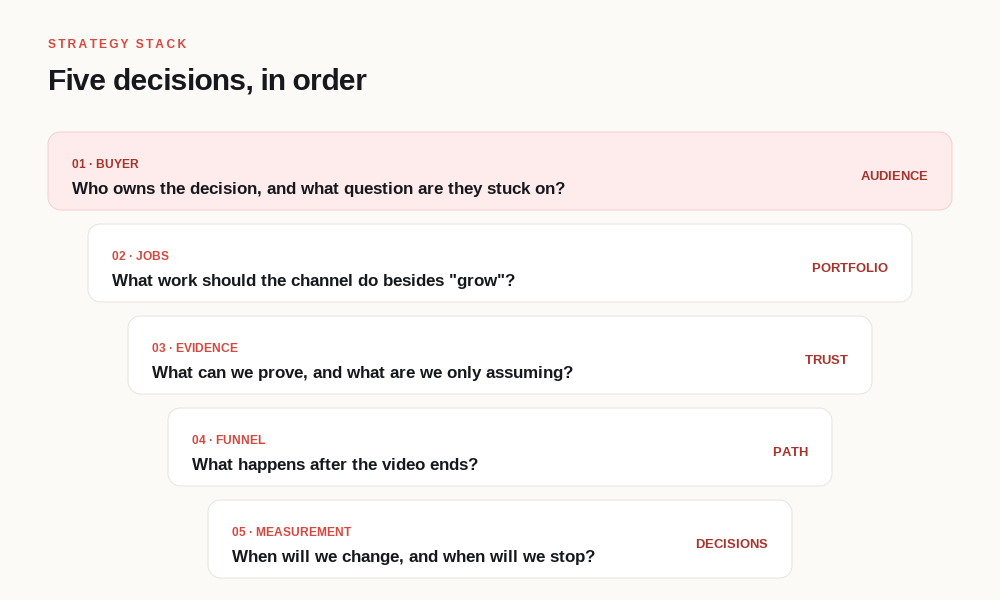
One decision at a time. A strategy that rules out nothing has not been made yet.
#Decision 1: Name the buyer and the decision they own
"Marketing leaders" is not a buyer. It is a department label. A useful definition names a person, a moment, and the decision they are stuck on.
- Weak: "We want to reach marketing leaders at SaaS companies."
- Better: "We want to help an operations lead at a mid-market SaaS company choose between two implementation approaches before a discovery call."
- Best: add the trigger. "They have just been burned by a migration that took three months and now need to defend a timeline to finance."
The trigger matters because it tells you what the viewer already believes. A person who has been burned is not looking for an introduction to the category. They are looking for failure modes, checklists, and someone who understands why the last project slipped. A person who has never heard of the category needs a different video entirely.
Do this for the buying committee, not only one persona. A B2B purchase usually involves an operator who will use the thing, a manager who will pay for it, and an executive who will ask why it matters. Your channel does not need a video for each of them, but it should know which one it is currently serving and what that person needs to believe before the next conversation.
Write the answer in one sentence and put it at the top of the strategy document. Every proposed video must name the sentence it serves. If it cannot, the video is a nice idea with no strategic home.
#Decision 2: Choose the jobs the channel will do
"Grow the channel" is not a job. It is an outcome with no method attached. The useful unit is a job-to-be-done: the work a video performs for the viewer and for the business.
- Problem education helps a viewer decide whether a problem applies to them and name it in their own language.
- Evaluation compares approaches or categories against explicit criteria, including your own product's limitations.
- Implementation shows steps, prerequisites, failure modes, and what to do when the process breaks.
- Evidence presents a real example, test, or demonstration with enough context to interpret it.
- Point of view makes a defensible claim about a change in the market, with evidence separated from opinion.
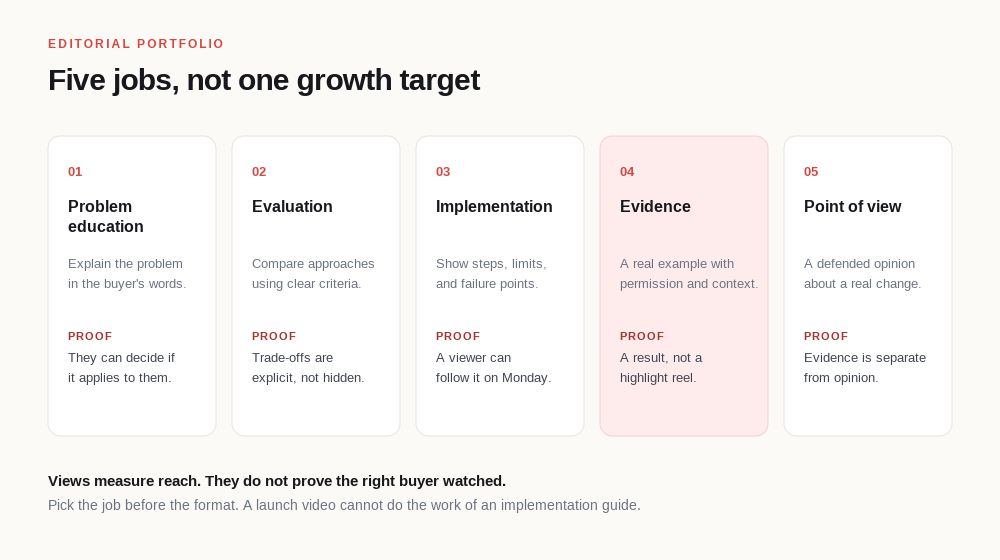
Five jobs, five different proofs. A portfolio is not a publishing ratio.
There is no magic ratio. The right mix follows from the buyer decision in step one. If your buyer is stuck on implementation, a calendar full of category education is a expensive way to be irrelevant. If your buyer does not yet know the category exists, a library of advanced tutorials is a lecture hall with no students.
Titles, descriptions, and chapters are how a viewer finds the right job in your catalog; our YouTube SEO guide covers those mechanics. Use the jobs to set different success criteria. Problem education is judged on retention and qualified traffic. Evaluation is judged on click-through and movement to a comparison page. Implementation is judged on completion and support deflection. Evidence is judged on whether sales actually sends it. Point of view is judged on conversation quality, not conversions. One metric across five jobs produces five bad decisions.
#One channel or several?
For almost every small B2B team, one channel is the right answer. Separate channels split the audience, dilute the publishing rhythm, and double the review burden. Use playlists and chapters to create structure inside one channel. The exception is a genuinely different audience with a genuinely different buying cycle — and even then, prove you can sustain one channel first.
#Decision 3: Decide what the channel can prove
This is where most B2B YouTube content quietly becomes fiction. A video says "teams save hours" or "this is what buyers want," and the evidence is a view count or a strong opinion.
Public competitor data cannot supply proof. YouTube's Data API exposes titles, dates, formats, public views, likes, and comments. It does not expose impressions, click-through rate, retention, or traffic sources for someone else's channel. Those require the channel owner's authorization through the YouTube Analytics API. Use public data to find questions, not to prove demand. Our competitor analysis guide covers the full method.
What you can prove comes from three sources:
| Source | What it supports | Limit |
|---|---|---|
| Your own channel analytics | How viewers found, clicked, and watched your videos | Only your channel; no causal claim about revenue |
| Customer and support conversations | What questions recur and in whose words | Small, biased toward people who already bought |
| Documented tests and product validation | What actually happened under stated conditions | Narrow; must state the conditions |
A customer story needs permission, context, and a result that survives scrutiny. A test needs a method and a sample size. An opinion needs to be labeled as an opinion. None of these is optional if the claim matters.
When a team cannot supply evidence, the honest move is to narrow the claim. "We think this is worth testing" is a perfectly good sentence in a brief. "This is what the market wants" without evidence is not. Google's helpful content guidance is a useful external standard here: a page should exist to help a reader, not to win an argument with a competitor.
#Decision 4: Connect the channel to the rest of the funnel
A video that ends with "thanks for watching" is a dead end. B2B YouTube works when each piece has a next step that fits the job it just did.
- A problem-education video can link to a diagnostic checklist or a related article.
- An evaluation video can link to a comparison page with explicit criteria. Our evaluation guide is an example of a page built for that moment.
- An implementation video can link to documentation, a template, or a help center article.
- An evidence video can be sent by sales during a live deal — which means it needs a URL a rep can paste into an email.
Map the path before you produce the video. Which page should the viewer see next? Who owns that page? Does it exist? A CTA to a page that does not exist is worse than no CTA, because it teaches the viewer that your instructions are decorative.
Then give sales a way to use the channel. Put the video URLs in the places reps already work: the CRM, the sequence library, the onboarding email. Ask them which videos get forwarded and which ones collect dust. That qualitative signal is often more useful than a retention graph, because it tells you whether the content is doing a job someone actually has.
Attribution is hard and stays hard. Use UTM-tagged links, self-reported attribution on demo forms, CRM notes, and search visibility in Search Console. Treat them as a set of weak signals, not a receipt. A video can influence a deal without being the last click, and a last click can overstate a video that merely happened to be nearby.
#Decision 5: Choose the measurement and the stop rule
The fifth decision in a B2B YouTube strategy is not "track views." It is deciding in advance what would make you change, double down, or stop.
Our analytics guide is a tour of the metrics and where to find them. The SaaS growth guide covers the decision ladder they support. At the strategy level, three rules are enough:
- Compare like with like. Same job, same format, similar age, your own channel as the baseline.
- Use a cadence. 48 hours for a directional read, seven days for a follow-up decision, 28 days for durability, 90 days for the portfolio.
- Write the stop rule before the upload. If a piece earns nothing after two review cycles, narrow it, merge it, or retire it.
Stop rules are unpopular because they force a decision when a team is attached to a piece. That is exactly why they need to be written down early. A library is allowed to lose arguments with its audience. It is not allowed to keep publishing the same argument because nobody wants to have the conversation.
#The operating model
A strategy becomes real when it has roles, a rhythm, and a review loop.
| Element | A sustainable version |
|---|---|
| Owner | One person responsible for the channel's decisions, not only its uploads |
| Reviewer | A named editor who signs off on claims before publication |
| Cadence | One deep piece and one short piece per week for a small team |
| Briefs | One page, approved before drafting, with sources and limits |
| Research | One standing input from calls, support, or search each week |
| Review | Twenty minutes weekly; 28-day and 90-day checkpoints |
| Refresh | Scheduled at publication for anything tied to a product or policy |
The content calendar guide turns this into dates. The brief guide turns it into a one-page artifact a writer can start from. Notice that neither requires a large team. They require that someone keeps the decisions visible.
#A worked example: the first five videos
Decisions are easier to see when they turn into a concrete slate. Suppose the buyer decision is the migration scenario from step one: an operations lead who has been burned by a slow rollout and must defend a new timeline to finance. The channel is starting from zero. Here is a defensible first five.
| # | Working title | Job | Evidence needed | Next step |
|---|---|---|---|---|
| 1 | What to check before you migrate a workflow | Implementation | Product specialist validation; three support themes | Migration checklist |
| 2 | Two migration approaches, compared honestly | Evaluation | A worked example with stated conditions | Comparison page |
| 3 | Why the second migration usually goes faster | Problem education | Five buyer interviews | Diagnostic article |
| 4 | A teardown of one migration, with the numbers | Evidence | Customer permission and real dates | Implementation guide |
| 5 | The part of migration everybody schedules wrong | Point of view | The four earlier videos plus a named opinion | Comment prompt |
For example, the first video is an implementation piece rather than a category explainer. This buyer already knows the category; what they lack is a checklist they can defend. The third video exists because the executive in the buying committee needs a different proof than the operator. The fifth video is allowed to be an opinion, but it sits on top of four pieces of evidence rather than replacing them.
What is deliberately absent is a "what is workflow migration" explainer. It would be easy to make and would attract viewers who are nowhere near a purchase. A channel trying to earn trust with a narrow audience cannot afford to train its recommendations around a broad one.
The stop rule is written at the same time. If video one holds fewer than half of its viewers past the midpoint and produces no checklist downloads after 28 days, the team stops the series and interviews five buyers before making video two. That threshold is illustrative, not a benchmark; the point is that it exists before anyone uploads. A stop rule written after a disappointing result is not a stop rule. It is an excuse to keep going.
This is what a strategy looks like in practice: five decisions, five videos, and one condition under which the plan changes. Everything else — titles, thumbnails, cadence — is execution of choices already made.
#Six failure patterns
Publishing to fill a slot. The calendar drives the topic instead of the decision. Fix: make the brief the entry ticket and let the slot go empty if the brief is not ready.
One audience label for the whole buying committee. The operator and the executive need different proofs. Fix: name which person a video serves before you write it.
Borrowed evidence. A competitor's view count is not market demand. Fix: require a second signal from your own calls, support, or search data.
A single metric for five jobs. Reach targets turn implementation videos into spectacle. Fix: set the success criterion per job.
No next step. The video ends and the viewer has nowhere useful to go. Fix: map the destination page before production.
No stop rule. Underperforming pieces stay live forever because nobody owns the decision to retire them. Fix: a name, a date, and a written criterion.
#A 90-day rollout
| Phase | Work | Output |
|---|---|---|
| Days 1–15 | Name the buyer decision, choose jobs, write the evidence standard | One-page strategy memo |
| Days 16–30 | Build a scored gap queue and an approved brief template | Backlog of 8–12 candidates |
| Days 31–60 | Publish two pieces per week; map one next step per video | Eight live pieces with owners |
| Days 61–75 | First 28-day reviews; refresh one piece; stop one if warranted | Decision log with reasons |
| Days 76–90 | Portfolio review; adjust the job mix and the next quarter's queue | Revised strategy memo |
This B2B YouTube strategy is deliberately small. Ninety days is enough to learn whether the channel changes decisions. It is not enough to declare victory. A B2B YouTube program compounds through a body of work, not a launch week. In our experience, the teams that succeed are the ones still making the five decisions explicitly in month six, when the novelty has worn off and the calendar is the only thing keeping them honest.
#FAQ
#What is a B2B YouTube strategy?
It is a set of five explicit decisions: which buyer and decision the channel serves, which jobs the videos do, what evidence supports the claims, where the viewer goes next, and what will trigger a change or a stop. A publishing calendar is an output of those decisions, not a substitute for them.
#How long does B2B YouTube take to work?
Plan on a quarter to learn and two to see compounding. You need six to ten comparable uploads before a baseline means anything, and search-driven videos can keep accumulating views for months. Judge the program on a body of work rather than a single upload.
#Should B2B companies make long or short videos?
Both, for different jobs. Short videos are good for a single decision or a sharp observation. Long videos are better for implementation, evaluation, and evidence. Choose the length from the job the video must do, then compare performance only against videos of the same format.
#How do we measure YouTube's impact on pipeline?
Use a set of directional signals: UTM-tagged links, landing-page conversions, self-reported attribution, CRM notes, and sales conversations that mention a video. No single method is complete. State the limitation in the report rather than presenting a false precision.
#Do we need a large team for B2B YouTube?
No. One owner, one named reviewer, and twelve hours a week can sustain one deep piece and one short piece, provided you reserve time for briefs and review. A larger team helps with volume, but it does not fix a channel that has not made the five decisions.
#What should we do if a channel is not working?
Go through the five decisions in order. Most failures trace back to an unclear buyer, a job the audience does not need, or a claim the evidence cannot support. Fix the decision before you buy a tool or hire an editor. The tool will faithfully automate the wrong strategy.
A strategy is a set of choices you can explain on one page and defend in a meeting. If yours cannot be explained that way, the calendar is doing the thinking for you.
Sources
- YouTube Data API: video resource
Documents the public fields available for question research.
- YouTube Analytics API: reports.query
Shows which performance metrics require channel-owner authorization.
- Google Search Console: Performance report
One of the directional signals used to connect video work to search visibility.
- Google Search Central: Creating helpful, reliable, people-first content
External standard for claims and reader value.
Written and reviewed by Jean Cope for the ChannelWhisper editorial team. We may mention our own product in articles. Read our research method, disclosure, and corrections policy.
Ready to turn research into pipeline?
ChannelWhisper monitors competitor channels and generates ready-to-record briefs.
Keep reading
AI Content Checklist: 12 Checks Before You Publish
A printable AI content checklist of twelve checks in four groups, with a one-minute test and a definition of good for each one.
How to Refresh Old Content Without Rewriting It
A decision tree for old pages: keep, update, merge, rewrite in place, or retire — with the history and URLs worth preserving.
Topic Clusters for Small Content Teams
A pillar, six supporting articles, one intent per URL: how a two-person team builds topic clusters that actually get published.