
YouTube vs LinkedIn for B2B Demand Generation

They are not substitutes. Compare discovery, shelf life, proof, and the job each channel does — then decide where the next hour belongs.

On this page
#The question that wastes a meeting
The YouTube vs LinkedIn debate eats an hour and produces no decision. Every few months, a leadership team asks which one deserves the budget, and the discussion ends with "let's do both" — which is how you get neither.
YouTube vs LinkedIn is the wrong framing. They are not competing for the same job. One is a searchable library that compounds over months; the other is a moving feed that rewards a timely point of view. A B2B buyer may encounter both in the same evaluation, and the team that treats them as substitutes ends up asking each channel to do the other one's work badly.
The useful question is narrower: which job in our current funnel is undone, and which channel is built to do it? This guide compares the two on mechanics rather than hype, and gives you a rule for spending the next hour.
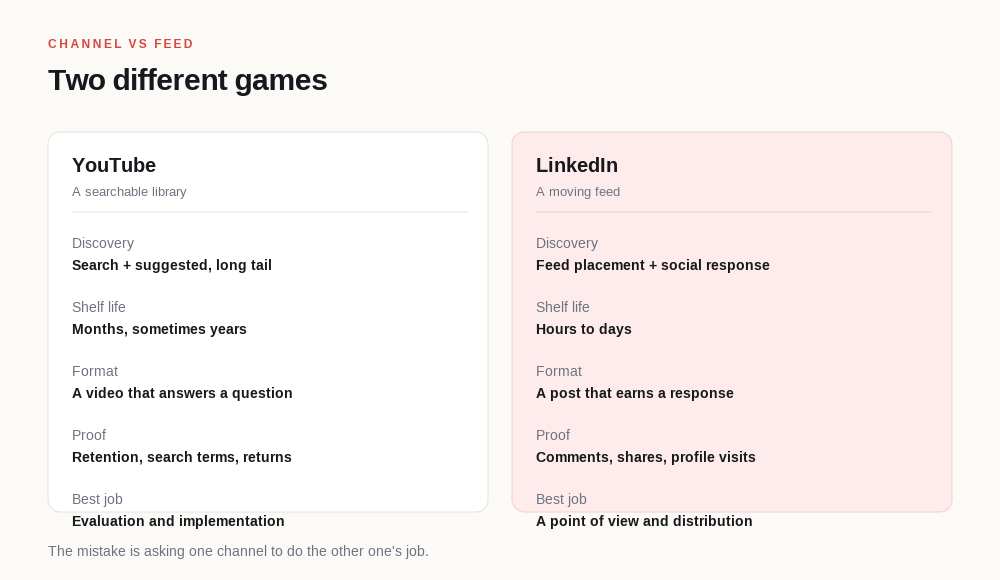
Two different games. The mistake is asking one channel to do the other one's job.
#YouTube vs LinkedIn: the honest comparison
| Dimension | YouTube | |
|---|---|---|
| Discovery | Search and suggested videos, long tail | Feed placement and social response |
| Shelf life | Months or years per video | Usually hours to days per post |
| Format | A video that answers a question | A post that earns a response |
| Proof | Retention, search terms, returning viewers | Comments, shares, profile visits |
| Best job | Evaluation and implementation | Point of view and distribution |
These are tendencies, not laws. Distribution mechanics change, and any specific claim about an algorithm should be verified against the platform's current documentation before you build a plan on it. What does not change is the structural difference between a library and a feed.
#What YouTube is built for
A YouTube video can be found six months after publication by someone who has never heard of you. That makes it a good home for answers that keep recurring: comparisons, implementation guides, and evidence. A small audience with a specific problem is enough. Our strategy pillar covers the job portfolio in detail.
The measurement is honest but incomplete. Public data gives you titles, dates, and public view counts through the Data API. Your own channel adds impressions, click-through, and retention through the Analytics API. What you cannot see is a competitor's private metrics or a clean causal link to revenue. Our attribution guide explains what can be claimed.
#What LinkedIn is built for
LinkedIn is a social feed. Its job is to put a point of view in front of people who may not be searching for it, and to make it easy for them to respond, repost, or remember your name. For a B2B team, that is valuable at the top of a category conversation: a controversial but defensible claim, a short observation from a real project, a question that starts a discussion.
The trade-off is shelf life. A post that performs on Tuesday is usually forgotten by Friday, and distribution depends on social response rather than a search query. That does not make it weak; it makes it a different instrument. Treat LinkedIn as distribution for ideas and YouTube as the place where those ideas get a full answer.
In our experience, the best LinkedIn posts for a B2B channel are not summaries of videos. They are the argument, posted on its own, with a link to the longer answer only if someone asks. A post that says "here is our new video" is an advertisement wearing a professional tone.
#Two ways teams waste the effort
Publishing the same asset in both places. A YouTube video dropped into LinkedIn as a link asks a feed audience to leave the feed. A LinkedIn text post uploaded as a YouTube video asks a search audience to watch someone read. Neither is repurposing; both are duplication with extra steps. The webinar repurposing workflow shows what real adaptation looks like.
Judging both with one metric. Views on LinkedIn are not views on YouTube, and neither is a pipeline number. A LinkedIn post that generates twenty thoughtful comments from buyers may be worth more than a video with 5,000 views from the wrong audience. Use channel-appropriate signals and a shared downstream measure. Our analytics guide covers the YouTube side.
#A rule for the next hour
When someone asks where the next hour of content effort should go, ask five questions:
- Is there a recurring buyer question with a weak public answer? That is a YouTube job.
- Is there a point of view the team needs to put into circulation? That is a LinkedIn job.
- Does the answer need three minutes of evidence to be credible? YouTube.
- Does the idea need a conversation to become clear? LinkedIn.
- Is the real problem that nobody has written a brief? Neither channel. Fix the brief. The brief workflow is the entry ticket.
If you answered "both" to the first two, you have the beginning of a paired plan: one short post stating the claim, one video carrying the evidence. They are not duplicates. They are two stages of the same argument.
#A sustainable split for a small team
One deep YouTube piece and two LinkedIn posts per week is realistic for a small team, provided the posts come from the same research rather than from extra work. The Monday video's thesis becomes Tuesday's post. Thursday's post asks the question the video left open. The content calendar guide shows how to schedule this without filling every slot.
Do not cross-post identical text. A LinkedIn post should make sense without the video; a video should make sense without the post. Link between them only where the next step genuinely helps the reader, and use tagged links so you can tell which channel sent the visit.
#A worked paired plan
For example, suppose the buyer question is "how do you keep a competitor tracker from going stale?" The current bottleneck is discovery: nobody in the category knows they have this problem yet.
- Monday, LinkedIn: a short post stating the claim — "A competitor tracker without a refresh rule is a spreadsheet with a subscription." No link. Ask one question at the end.
- Tuesday, YouTube: a six-minute video showing the refresh design, the quota arithmetic, and the failure mode. The Monday claim becomes the video's first thirty seconds.
- Thursday, LinkedIn: the question that drew the most replies, answered in three sentences with a link to the exact timestamp in the video.
- Friday: twenty minutes of review. Write down which post started a conversation and which video held attention, then choose next week's question.
We think the pairing matters more than the platform choice. A post without the video is an opinion with nowhere to land. A video without the post is an answer nobody in the feed knows to ask for.
Neither channel can manufacture evidence. If the team cannot name the buyer, the question, and the source behind the claim, moving the idea between platforms is only distribution of a guess. The content brief is where that gets fixed, and Google's helpful content guidance makes the same point from the reader's side: the page must help someone, not fill a channel.
#FAQ
#Should a B2B company be on YouTube or LinkedIn?
Both, if the team can sustain them. They do different jobs: YouTube is a searchable library for evaluation and implementation; LinkedIn is a feed for points of view and distribution. If resources allow only one, choose the channel that matches your current bottleneck — discovery of ideas or depth of answers.
#Is LinkedIn better for B2B lead generation?
The YouTube vs LinkedIn answer depends on the job. LinkedIn is strong at putting an idea in front of people who are not searching, which can start a conversation. YouTube is strong at answering a question someone is already asking, which can move an evaluation forward. Neither produces a clean causal lead number on its own.
#Can the same content work on both channels?
The same research can. The same asset usually cannot. A post that states an argument and a video that proves it are two pieces of content built from one idea. Dropping a video link into a feed or reading a post to a camera wastes what each channel is good at.
#How do I measure LinkedIn against YouTube?
Do not measure them against each other. Use channel-appropriate leading signals — comments and shares on LinkedIn, retention and search terms on YouTube — plus one shared downstream measure such as tagged visits, self-reported attribution, or CRM notes. Our attribution guide explains the confidence levels.
#What if we can only do one well?
Do the one that fixes the current bottleneck. If buyers keep asking the same implementation question, make the video. If nobody in your category knows you have a point of view, post it. A channel done well is worth more than two channels done badly, and you can add the second later.
The YouTube vs LinkedIn choice is rarely permanent. Teams add a channel when the job appears and stop feeding it when the job disappears. That is a strategy. Picking a platform in a meeting and defending the choice for three years is a hobby.
Sources
- YouTube Data API: video resource
Documents the public fields available for an outside observer.
- YouTube Analytics API: reports.query
Documents the authorized metrics available for your own channel.
- Google Search Console: Performance report
A search-side signal for your own site, complementary to channel metrics.
- Google Search Central: Creating helpful, reliable, people-first content
External standard for whether a page or post helps the reader.
Written and reviewed by Jean Cope for the ChannelWhisper editorial team. We may mention our own product in articles. Read our research method, disclosure, and corrections policy.
Ready to turn research into pipeline?
ChannelWhisper monitors competitor channels and generates ready-to-record briefs.
Keep reading
AI Content Checklist: 12 Checks Before You Publish
A printable AI content checklist of twelve checks in four groups, with a one-minute test and a definition of good for each one.
How to Refresh Old Content Without Rewriting It
A decision tree for old pages: keep, update, merge, rewrite in place, or retire — with the history and URLs worth preserving.
Topic Clusters for Small Content Teams
A pillar, six supporting articles, one intent per URL: how a two-person team builds topic clusters that actually get published.